
Copy trading is one of the most accessible ways to participate in crypto derivatives markets without needing to develop your own technical analysis skills. Instead of studying charts yourself, you allocate funds to follow a trader whose strategy and risk profile match your goals — and their positions are automatically replicated in your account.
Margex’s copy trading system is built directly into the platform — no third-party apps or manual signal execution required. This guide explains exactly how it works, how to choose traders to follow, and how to manage your copy portfolio for consistent results.
Key Takeaways
- Copy trading lets you automatically replicate the positions of experienced traders — when they open a trade, you open the same trade proportionally.
- Margex Copy Trading gives followers access to verified trader performance history before committing any funds.
- You control your risk: set a maximum allocation per trader and overall stop parameters for your copy portfolio.
- Copy trading is not passive income — you still need to select traders carefully, monitor performance, and adjust allocations over time.
- The best traders to copy are those with consistent risk-adjusted returns over 3+ months, not just peak recent performance.
- Margex charges no extra fees for using copy trading — followers pay the standard trading fees on executed positions.
What is Copy Trading?
Copy trading is an automated system where your account mirrors the trades of a chosen trader in real time. When the trader opens a position — say, a BTC long at $81,000 with 5× leverage — your account automatically opens the same direction and pair, scaled proportionally to your allocated funds.
| Without copy trading | With copy trading |
| Monitor charts yourself | Trader monitors charts for you |
| Manual order placement | Orders execute automatically |
| Requires TA knowledge | Knowledge of trader selection needed |
| Full control of every trade | Limited control (set by allocation settings) |
| Results depend on your skills | Results depend on trader’s skills + your selection |
How Margex Copy Trading Works
- Browse traders. In the Margex copy trading section, view a leaderboard of traders with verified performance statistics: win rate, total return, max drawdown, active followers, and trading style.
- Analyse performance. Review a trader’s full history — not just recent returns. Look for consistent win rates above 55%, max drawdown below 30%, and at least 3 months of live tracked history.
- Set your allocation. Choose how much USDT to allocate to each trader. Your trades are sized proportionally — if the trader uses 5% of their portfolio on a trade, you use 5% of your allocated amount.
- Set risk limits. Configure maximum loss parameters — if your copy portfolio drops by a defined percentage, copying stops automatically. This protects you from catastrophic losses if a trader has a bad streak.
- Monitor and adjust. Check your copy portfolio weekly. Redistribute allocations based on ongoing performance. Remove traders who show declining results or significant drawdown.
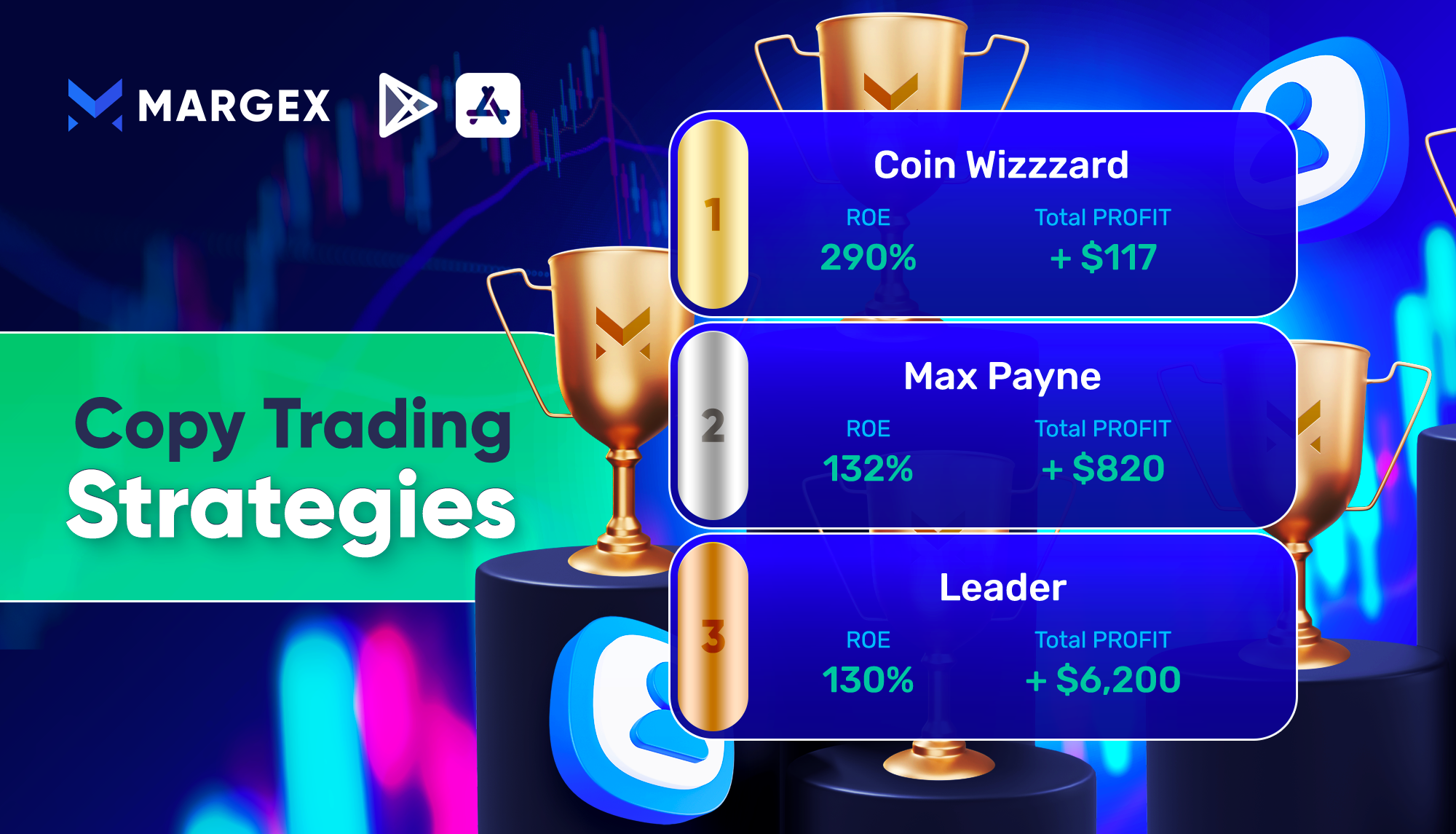
How do you choose a provider for copy trading?
Copy Trading is like in the market: suppliers show the products with their faces and scores. The higher the rating, the more expensive the subscription is for the signals. New providers often sell signals for free to get a rating; if you don’t have enough money for signals from in-demand providers, you can start using the free ones.The higher the rating, the more expensive the subscription is. Choose a provider wisely:
• The trading history must be extended (not less than 60 days), and there must not be enough offers.
• A large number of subscribers say that the trader is in demand.
• Estimate the trader’s strategy; how many daily operations does he carry out? If he is a scalper, isn’t his strategy too risky?
• The maximum reduction should not exceed 25-30%.
• An average monthly income is 15-30%.
Social Trading vs. Copy Trading

While copy trading is often categorized as a subset of social trading, these two approaches exhibit distinct differences.In copy trading, your account becomes linked with another trader, and their positions are automatically duplicated in your account. Your success is tied to theirs – if they profit, so do you; conversely, losses are shared. This method is notably more passive, as the trader you’re copying does all the work. Frequently, the entire process is automated.
Nevertheless, specific platforms and copy trading applications operate semi-automated, allowing you to choose which trades to replicate. Copy trading is particularly advantageous for novice traders, allowing them to engage in trading beyond their current level of expertise. However, drawbacks include limited learning opportunities and potential losses following unsuccessful traders.
Conversely, social trading adopts a more extensive approach, integrating social media into investing. The primary emphasis is community engagement, allowing traders to interact, share insights, and receive notifications about each other’s trading activities.
Social trading platforms often incorporate features like message boards and chat rooms for trading discussions, customizable social news feeds that keep investors updated on their preferred traders’ activities, and extensive trader statistics. For instance, in apps like AvaSocial, investors access portfolio details, risk scores, personal news feeds, and success/failure ratios.This strategy not only enables learning but also encourages active contribution to the community. It provides investors with a wealth of resources for informed decision-making.
Both social trading and copy trading prove valuable. However, the key lies in choosing a strategy that aligns with your current trading requirements and preferences. AvaTrade presents diverse solutions, including the AvaSocial trading app and copy trading platforms. Selecting the one that aligns most closely with your trading needs is essential for a successful investment journey.
Why Has Copy Trading Become So Popular?
Copy investing, or mirror trading, has become very popular with investors worldwide, mainly because many early adopters have had enormous success and were able to boost their trading skills and profitability with zero effort. Copy trading enables novice investors to do just that. They don’t need to know how to analyze the markets or how to interpret trading signals or indicators.
Novices are using other investors’ abilities and thus increasing their success rates. Also, copy trading can be used by experienced traders as a way of learning new trading strategies from others and, by that, increasing their success in the online trading market.
If you would like to start investing in the stock market but do not have a lot of experience, or you are a seasoned pro who would like to gain insight into the analysis of others, using copy investing/mirror trading could be an excellent place for you to begin.
How to Choose Traders to Copy on Margex
Trader selection is the most important decision in copy trading. These are the metrics that matter:
| Metric | Target range | Why it matters |
| Win rate | 55–70% | Below 55% is marginal; above 75% needs scrutiny |
| Risk/Reward ratio | >1.5:1 | Positive R/R means profitable even below 50% win rate |
| Max drawdown | <25% | High drawdown = high risk of wiping your allocation |
| Track record length | >3 months | Short history can be lucky — longer is more reliable |
| Trading style | Match your risk tolerance | Scalpers vs swing traders have very different risk profiles |
| Leverage used | <20× average | High leverage = high volatility in your copy portfolio |
Browse top traders on Margex and start copy trading — Open Copy Trading
FAQ
How does Margex copy trading work?
Margex copy trading automatically replicates the positions of chosen traders in your account, proportional to your allocation. When a trader opens or closes a position, your account does the same in real time. You choose which traders to follow, how much to allocate, and set maximum loss limits.
Is copy trading profitable on Margex?
Profitability depends on the traders you copy. Carefully selected traders with 3+ months of verified history and consistent risk management can deliver positive returns. However, copy trading carries risk — traders can and do lose money. Diversify across multiple traders and set maximum drawdown limits.
What is the minimum to start copy trading on Margex?
The minimum deposit on Margex is $10. You can allocate any portion of your account balance to copy trading. For meaningful diversification, allocating $100–$500 across 3–5 traders is a practical starting point.
Does Margex charge fees for copy trading?
Margex does not charge performance fees or subscription fees for copy trading. Followers pay the standard Margex trading fees (0.02% maker / 0.06% taker) on each executed copied trade — the same as manual trading.
How do I choose the best traders to copy on Margex?
Filter by: win rate above 55%, max drawdown below 25%, track record of 3+ months, average leverage below 20×, and a risk/reward ratio above 1.5:1. Avoid traders with extremely short histories showing unusually high returns — these are often unsustainable.